Summary
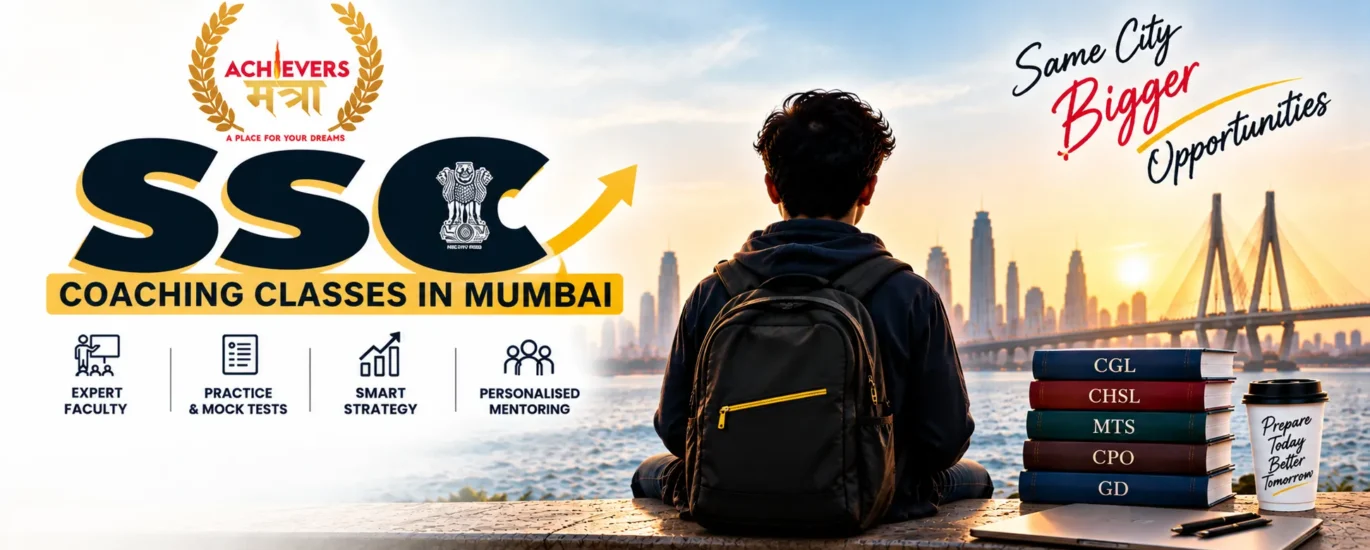
Finding the right SSC coaching classes in Mumbai can be an important step for students preparing for competitive government examinations. SSC conducts multiple examinations for recruitment to different posts, including SSC CGL, SSC CHSL, SSC MTS, SSC CPO, SSC GD, SSC Selection Post and SSC Junior Engineer.
However, joining a coaching institute alone does not guarantee success. A useful SSC preparation programme should combine structured syllabus coverage, experienced teaching, quality study material, previous-year questions, regular mock tests, doubt solving, performance analysis, revision and personalised guidance.
This comprehensive guide explains how to select SSC coaching classes in Mumbai, what subjects to study, how to prepare for SSC examinations, how mock tests should be used, the difference between online and classroom coaching, and what students should consider before enrolling.
Achievers Mantra offers government-exam preparation for students in the Thane and Mumbai region, with its website currently describing SSC preparation for examinations including CGL, CHSL and MTS along with study material, mock tests and personalised guidance.
Introduction
Government jobs continue to attract a large number of graduates, undergraduate students and other eligible candidates across India. Among the major recruitment bodies, the Staff Selection Commission (SSC) conducts several examinations for different government positions.
For students searching for SSC coaching classes in Mumbai, the number of available options can make the decision difficult.
Should you choose classroom coaching or online classes?
How important are mock tests?
Do you need separate coaching for SSC CGL and SSC CHSL?
How much study material is enough?
What should you look for in an SSC coaching institute?
These are important questions because SSC preparation requires much more than simply completing a syllabus.
A candidate needs to develop conceptual clarity, speed, accuracy, question-selection ability and examination temperament. Regular practice and analysis are equally important.
The official SSC calendar for 2026–27 includes examinations such as SSC CGL, SSC CHSL, SSC MTS & Havaldar, SSC CPO, SSC GD, Selection Post and other examinations. The calendar is tentative, so candidates should always check the latest official notification before relying on dates or recruitment details.
For students living in Mumbai, Thane, Navi Mumbai and nearby areas, choosing a coaching centre should also involve practical considerations such as travel time, batch timings, course structure and access to tests and doubt-solving.
What Is the SSC?
SSC stands for Staff Selection Commission.
It conducts recruitment examinations for various posts in government departments, ministries, offices and organisations under the Government of India.
Different SSC examinations have different:
- Eligibility requirements
- Age criteria
- Syllabi
- Examination stages
- Selection procedures
- Skill or physical requirements
- Post preferences
Therefore, students should first identify the examination they are eligible for before selecting an SSC coaching programme.
Major SSC Examinations
1. SSC CGL
The Combined Graduate Level Examination (SSC CGL) is one of the most popular SSC examinations.
It is intended for eligible graduate-level candidates and provides recruitment opportunities across different government departments and organisations.
SSC CGL preparation generally requires substantial practice in:
- Quantitative Aptitude
- General Intelligence and Reasoning
- English
- General Awareness
- Relevant advanced topics for subsequent stages
Students preparing for CGL often benefit from a systematic long-term preparation plan.
2. SSC CHSL
The Combined Higher Secondary (10+2) Level Examination, commonly called SSC CHSL, is another major SSC examination.
Candidates preparing for CHSL generally work on:
- English
- Quantitative Aptitude
- General Intelligence
- General Awareness
- Computer-related knowledge where applicable
- Typing or skill requirements where applicable
The official 2026–27 SSC calendar lists SSC CHSL Tier-I in the July–September 2026 period. Because SSC schedules can be revised, candidates should verify the latest notification.
3. SSC MTS
The Multi-Tasking Staff and Havaldar Examination is another popular SSC recruitment examination.
Preparation typically includes:
- Numerical and mathematical ability
- Reasoning
- General Awareness
- English
The official 2026–27 calendar places the MTS & Havaldar examination in the September–November 2026 period.
4. SSC CPO
SSC CPO is associated with recruitment for Sub-Inspector positions in Delhi Police and Central Armed Police Forces.
Candidates preparing for this examination need to consider both academic preparation and the relevant physical requirements of the recruitment process.
5. SSC GD
The SSC GD Constable examination is associated with recruitment for Constable (GD) positions in specified forces.
Preparation generally involves:
- Reasoning
- Elementary Mathematics
- General Knowledge
- General Awareness
- English or Hindi
Physical preparation is also relevant to applicable recruitment stages.
The SSC’s 2026–27 calendar lists the GD Constable examination cycle for January–March 2027.
Why Choose SSC Coaching Classes in Mumbai?
SSC preparation can certainly be done through self-study. However, some students prefer coaching because it provides a structured preparation environment.
1. Structured Learning
SSC has a large syllabus.
A coaching programme can divide the syllabus into smaller modules and create a sequence for learning.
Instead of wondering what to study every day, students can follow a defined curriculum.
2. Faculty Guidance
An experienced teacher can help students understand:
- Concepts
- Short methods
- Common mistakes
- Question patterns
- Time-saving approaches
- Previous-year trends
This can be particularly helpful for students who struggle to understand difficult topics independently.
3. Regular Practice
SSC is a practice-oriented examination.
Students need to solve questions repeatedly to improve:
- Speed
- Accuracy
- Calculation
- Question selection
- Time management
Regular classroom or online assignments can create a consistent practice routine.
4. Mock Tests
Mock tests simulate examination conditions.
They help students determine:
- Current score
- Accuracy
- Speed
- Weak subjects
- Weak chapters
- Time-consuming question types
5. Doubt Solving
A student can lose substantial preparation time when a concept remains unclear.
Doubt-solving sessions can help students resolve specific problems instead of repeatedly studying the same topic.
6. Personalised Guidance
Every student has different strengths and weaknesses.
One student may be strong in English but weak in mathematics.
Another may have excellent Quant skills but struggle with General Awareness.
Personalised guidance allows preparation to be adjusted accordingly.
How to Choose SSC Coaching Classes in Mumbai
The word “best” is highly subjective when selecting a coaching institute. Instead of relying solely on advertisements or rankings, compare the features that directly affect your preparation.
1. Check the Faculty
Look for faculty who can:
- Explain concepts clearly
- Solve questions using multiple methods
- Teach shortcuts where appropriate
- Discuss previous-year questions
- Explain common mistakes
- Help students improve speed and accuracy
If possible, attend a demo class before enrolling.
2. Evaluate the Study Material
Good SSC study material should be:
- Well organised
- Topic-wise
- Easy to revise
- Relevant to the targeted examination
- Supported by practice questions
- Updated when the examination pattern changes
Avoid collecting excessive material.
The objective is not to own ten books for one subject. The objective is to understand, practise and revise.
3. Look at the Mock-Test System
Ask the coaching institute:
- How many tests are included?
- Are topic-wise tests available?
- Are sectional tests available?
- Are full-length mocks available?
- Is performance analysis provided?
- Are previous-year papers included?
- Can students review incorrect questions?
Mock tests become significantly more useful when detailed analysis is part of the programme.
Achievers Mantra’s current government-exam preparation page describes SSC preparation with mock tests, study material and performance-oriented guidance.
4. Check Doubt-Solving Facilities
Before joining, find out whether students can ask doubts:
- During class
- After class
- Through dedicated sessions
- Through online platforms
- Through one-to-one interaction
Students should not hesitate to ask about the actual process rather than assuming that doubt support is included.
5. Consider Batch Size
A very large batch may make individual interaction difficult.
A smaller batch can potentially make it easier to:
- Ask questions
- Participate in discussions
- Receive individual attention
- Discuss mistakes
However, batch size should be evaluated together with faculty quality and the overall course structure.
6. Check Batch Timings
Mumbai students often combine competitive-exam preparation with:
- College
- Part-time work
- Full-time jobs
- Internships
- Other responsibilities
Therefore, check whether the institute offers:
- Morning batches
- Evening batches
- Weekend batches
- Online classes
- Recorded sessions
Achievers Mantra currently highlights flexible batches and special weekend batches among its stated coaching features.
SSC Syllabus: Subjects You Need to Prepare
Although the exact syllabus and stages vary by examination, SSC aspirants commonly need preparation in several core areas.
Quantitative Aptitude
Quant can be one of the most important areas for SSC preparation.
Important topics include:
Arithmetic
- Percentage
- Ratio and Proportion
- Average
- Profit and Loss
- Discount
- Simple Interest
- Compound Interest
- Time and Work
- Pipes and Cisterns
- Time, Speed and Distance
- Trains
- Boats and Streams
- Partnership
- Mixture and Alligation
Advanced Mathematics
Depending on the examination and stage:
- Algebra
- Geometry
- Mensuration
- Trigonometry
- Number System
- Data Interpretation
The goal should not simply be memorising formulas.
You should understand:
Concept → Formula → Application → Practice → Speed
General Intelligence and Reasoning
Reasoning can include topics such as:
- Analogy
- Classification
- Series
- Coding-Decoding
- Blood Relations
- Direction Sense
- Ranking
- Venn Diagrams
- Syllogism
- Statement-based questions
- Non-verbal reasoning
- Figure-based questions
- Puzzles
The more questions you solve, the easier it becomes to recognise common patterns.
English Language
English preparation should cover both grammar and comprehension.
Important areas include:
- Parts of Speech
- Tenses
- Subject-Verb Agreement
- Articles
- Prepositions
- Active and Passive Voice
- Direct and Indirect Speech
- Error Detection
- Sentence Improvement
- Fill in the Blanks
- Cloze Test
- Reading Comprehension
- Para Jumbles
- Synonyms
- Antonyms
- One-Word Substitution
- Idioms and Phrases
- Vocabulary
A daily vocabulary routine can be particularly useful.
For example, learn 10–15 words, revise older words and then use them in practice questions.
General Awareness
General Awareness is broad and requires continuous revision.
Students should consider studying:
History
- Ancient India
- Medieval India
- Modern India
- Indian Freedom Movement
Geography
- Physical Geography
- Indian Geography
- Rivers
- Climate
- Agriculture
- Natural Resources
Polity
- Constitution
- Fundamental Rights
- Parliament
- President
- Prime Minister
- Supreme Court
- Constitutional bodies
Economics
- Basic economic concepts
- Inflation
- Banking
- Monetary policy
- Fiscal policy
- Budget
- National income
General Science
- Physics
- Chemistry
- Biology
- Everyday science
Current Affairs Preparation
Current affairs should be studied systematically.
Instead of trying to remember every news story, focus on relevant categories such as:
- Government schemes
- National events
- International events
- Appointments
- Awards
- Sports
- Science and technology
- Important reports
- Economy
- Important organisations
Maintain short revision notes.
Previous-Year Questions: Why They Matter
Previous-year questions should be a central part of SSC preparation.
They help you understand:
- Question structure
- Difficulty
- Frequently tested concepts
- Common traps
- Time requirements
- Your own weaknesses
Do not simply solve a PYQ and move on.
After every practice session, ask:
Why did I get this question wrong?
Possible reasons include:
- Conceptual mistake
- Calculation error
- Misreading
- Lack of knowledge
- Time pressure
- Careless mistake
Maintain an error notebook containing the questions you repeatedly get wrong.
Importance of Mock Tests
Mock tests are one of the most useful tools in competitive-exam preparation.
However, simply taking mock tests is not enough.
A Better Mock-Test Process
Step 1: Take the Test
Attempt it under strict examination conditions.
Step 2: Record the Score
Record:
- Total score
- Accuracy
- Attempted questions
- Correct questions
- Incorrect questions
- Unattempted questions
Step 3: Analyse
Identify:
- Weak chapters
- Slow questions
- Careless mistakes
- Knowledge gaps
Step 4: Correct
Study the relevant concept.
Step 5: Reattempt
Solve similar questions again.
This creates a continuous improvement cycle.
SSC Preparation Strategy for Beginners
If you are starting from zero, do not attempt to finish the complete syllabus in a few days.
Use a gradual approach.
Phase 1: Understand the Examination
Learn:
- Eligibility
- Syllabus
- Selection process
- Examination stages
- Marking system
- Relevant subjects
Always verify these details from the latest official SSC notification.
Phase 2: Build Fundamentals
Start with basic concepts.
For Quant:
- Number system
- Percentage
- Ratio
- Average
For Reasoning:
- Series
- Analogy
- Classification
- Coding
For English:
- Grammar
- Vocabulary
- Sentence structure
For General Awareness:
- Basic static GK
- History
- Geography
- Polity
- Science
Phase 3: Start PYQs
Once basic concepts are clear, begin solving previous-year questions.
This connects classroom theory with actual exam-style practice.
Phase 4: Start Sectional Tests
Take subject-specific tests.
For example:
- Quant sectional test
- Reasoning sectional test
- English test
- General Awareness test
Phase 5: Full-Length Mock Tests
After building sufficient fundamentals, begin full-length mocks.
Gradually increase the frequency as the examination approaches.
Three-Month SSC Study Plan
Month 1 — Fundamentals
Focus on:
- Basic concepts
- Formulas
- Grammar
- Vocabulary
- Reasoning fundamentals
- Static GK
Target:
Build accuracy first.
Month 2 — Practice
Focus on:
- Topic-wise questions
- PYQs
- Sectional tests
- Speed improvement
- Weak topics
- General Awareness revision
Month 3 — Mock Tests
Focus on:
- Full-length mocks
- Revision
- Error analysis
- Time management
- Weak chapters
- Formula revision
Avoid changing resources constantly during this stage.
Six-Month SSC Preparation Plan
Students with six months can divide preparation into broader phases.
Months 1–2
Complete the fundamentals.
Months 3–4
Finish the syllabus and focus heavily on PYQs.
Month 5
Increase sectional and full-length testing.
Month 6
Focus on:
- Revision
- Mock tests
- Error correction
- Weak areas
- Examination strategy
Daily SSC Study Schedule
A full-time aspirant could structure the day like this:
| Activity | Approximate Time |
|---|---|
| Quantitative Aptitude | 2 hours |
| Reasoning | 1.5 hours |
| English | 1.5 hours |
| General Awareness | 1 hour |
| Current Affairs | 30 minutes |
| Revision / Test Analysis | 1 hour |
This is only an example.
Students should adjust the schedule according to their level and available time.
SSC Preparation for Working Professionals
Working professionals can use a different strategy.
Before Work
- Vocabulary
- Current Affairs
- 20–30 Quant questions
After Work
- Coaching class
- Reasoning practice
- English practice
Weekend
- Full-length mock
- Mock analysis
- Revision
- Backlog completion
Consistency is more important than attempting unrealistic study schedules.
Online vs Offline SSC Coaching Classes in Mumbai
Both formats have advantages.
Offline Coaching
Can provide:
- Classroom interaction
- Direct teacher access
- Fixed schedule
- Peer learning
- Structured environment
Online Coaching
Can provide:
- Flexible location
- Recorded classes
- Easy revision
- No daily commute
- Flexible scheduling
Hybrid Learning
A combination can also work:
Classroom coaching + online revision + mock tests + self-study
The right option depends on your personal circumstances.
SSC Coaching in Mumbai or Thane?
When searching for SSC coaching classes in Mumbai, students should consider the wider Mumbai Metropolitan Region.
For a student living in Thane, travelling into central Mumbai every day may not always be practical. Similarly, a student living in Andheri or Dadar may prefer a centre closer to home.
Factors to compare include:
- Travel time
- Local train accessibility
- Class timings
- Weekend batches
- Online support
- Faculty
- Study material
- Test series
Achievers Mantra’s government-exam page specifically positions its SSC preparation for the Thane and Mumbai region and lists its centre at Ganesh Tower, Naupada, Thane West.
SSC Coaching at Achievers Mantra
Achievers Mantra is an education and competitive-exam coaching institute serving students in the Thane and Mumbai region.
Its website currently highlights:
- Comprehensive study material
- Personalised mentoring
- Assistance through preparation
- Mock-test support
- Experienced educators
- Doubt-solving
- Flexible batches
- Weekend batches
Its government-exam preparation page currently includes SSC CGL, SSC CHSL and SSC MTS among its SSC preparation offerings, along with other government examinations.
For students considering the institute, it is useful to confirm the current SSC course schedule, fees, batch timings, faculty, test series and course inclusions directly with Achievers Mantra before enrolling.
The institute’s listed location is:
903, Ganesh Tower, Opposite Platform No. 1, Dada Patil Road, Naupada, Thane West, Maharashtra 400602.
This makes the location particularly relevant for students searching for SSC coaching in the Thane–Mumbai region.
Common Mistakes SSC Aspirants Should Avoid
1. Studying Without a Plan
Randomly selecting topics every day makes it difficult to track progress.
Create a weekly plan.
2. Using Too Many Resources
Too many books and online courses can create confusion.
Choose reliable resources and revise them thoroughly.
3. Ignoring PYQs
Previous-year questions should not be left until the final stage.
Start them early.
4. Avoiding Mock Tests
Do not wait until the final weeks to begin taking tests.
Testing should be integrated into preparation.
5. Not Analysing Tests
A score alone does not tell you how to improve.
Analyse every important mistake.
6. Focusing Only on Strengths
If you are good at Reasoning but weak in Quant, spending five additional hours on Reasoning may not be the best use of preparation time.
Work on your weaker areas.
7. Ignoring Revision
Students often learn new topics continuously without revising old ones.
Create weekly revision sessions.
8. Changing Teachers and Books Frequently
Constantly changing your preparation resources can waste time.
Once you find a resource that works, use it consistently.
How to Improve Speed and Accuracy
SSC preparation requires a balance between speed and accuracy.
Step 1: Build Conceptual Clarity
Understand the method.
Step 2: Practise Slowly
Initially prioritise correct solutions.
Step 3: Identify Shortcuts
Once the concept is strong, learn faster methods where appropriate.
Step 4: Use Timed Practice
Solve sets under time constraints.
Step 5: Analyse Mistakes
Determine why you lost time or marks.
This gradually improves examination efficiency.
How to Make the Most of SSC Coaching
Joining an institute is only the beginning.
To get maximum value from coaching:
Attend Classes Regularly
Avoid unnecessary absences.
Complete Assignments
Do not allow backlogs to accumulate.
Ask Questions
If something is unclear, ask the faculty.
Revise the Same Day
Spend 20–30 minutes reviewing class notes.
Solve PYQs
Connect concepts with actual questions.
Attempt Mock Tests
Test yourself regularly.
Maintain an Error Book
Record repeated mistakes.
SSC Coaching Fees in Mumbai
Coaching fees vary according to the programme.
Factors can include:
- SSC examination
- Course duration
- Number of subjects
- Classroom or online format
- Study material
- Mock tests
- Faculty
- Mentoring
- Batch size
- Additional support
Before paying, ask exactly what the fee includes.
A useful comparison checklist is:
| Feature | Questions to Ask |
|---|---|
| Classes | How many sessions? |
| Faculty | Who teaches each subject? |
| Study Material | Is it included? |
| Tests | How many mocks? |
| PYQs | Included or separate? |
| Doubts | How are doubts handled? |
| Revision | Are revision classes included? |
| Recordings | Are recordings available? |
| Validity | How long is access provided? |
| Batches | Weekday/weekend options? |
Frequently Asked Questions About SSC Coaching Classes in Mumbai
1. Which SSC coaching classes should I choose in Mumbai?
Compare coaching institutes based on faculty, course structure, study material, mock tests, doubt-solving, mentoring, batch timings, location and fees. The most suitable institute depends on the individual student’s requirements.
2. Is coaching necessary for SSC preparation?
No. SSC can be prepared through self-study. Coaching can nevertheless provide structured lessons, faculty guidance, tests and accountability.
3. Which SSC exam is suitable after graduation?
SSC CGL is one major graduate-level examination, but eligibility varies by examination and post. Candidates should check the latest official notification for their target examination.
4. Can 12th-pass students prepare for SSC exams?
Yes. Some SSC examinations have eligibility requirements based on 10+2 qualifications. SSC CHSL is a major examination associated with the 10+2 level, subject to the specific notification requirements.
5. Is SSC CGL coaching available in Mumbai?
Yes. There are coaching providers across Mumbai and the wider metropolitan region offering competitive-exam preparation. Students should compare the actual course features before enrolling.
6. Can I prepare for SSC while working?
Yes. Working professionals can use evening, weekend or online classes and supplement them with self-study.
7. How many hours should I study for SSC?
There is no universal number of hours. Study time should depend on your current preparation level, target examination and available schedule.
8. Are SSC mock tests important?
Yes. Mock tests can help improve speed, accuracy, time management and question selection. Their effectiveness increases when candidates analyse their performance afterwards.
9. Should I solve previous-year SSC papers?
Yes. PYQs help candidates become familiar with question formats, recurring concepts and the level of difficulty.
10. Is online or offline SSC coaching better?
Neither format is automatically better for every student. Classroom coaching provides direct interaction, while online coaching provides flexibility. Choose the format that you can follow consistently.
11. Does Achievers Mantra offer SSC preparation?
Yes. Achievers Mantra’s current government-exam page lists preparation for SSC examinations including CGL, CHSL and MTS, along with study material, mock tests and personalised guidance.
12. Where is Achievers Mantra located?
Achievers Mantra lists its centre at 903, Ganesh Tower, Opposite Platform No. 1, Dada Patil Road, Naupada, Thane West, Maharashtra 400602.
13. Can beginners join SSC coaching?
Yes. Beginners can use structured coaching to build fundamentals before moving to advanced practice, PYQs and mock tests.
14. How early should I start SSC preparation?
Starting earlier gives you more time for fundamentals, practice, revision and mock tests. However, the required preparation period depends on the candidate’s starting level and target examination.
15. How can I improve my SSC mock-test score?
Analyse every mock. Identify weak chapters, careless mistakes, slow questions and knowledge gaps. Then revise those areas and take another test.
16. Is SSC coaching in Thane useful for Mumbai students?
It can be practical for students who live in Thane or nearby parts of Mumbai and prefer a location with convenient travel. Commute time should be considered alongside faculty, course structure and other factors.
SSC Preparation Checklist
Before the examination, make sure you have:
Syllabus
- Understood the complete syllabus
- Identified important topics
- Created a study plan
Concepts
- Completed fundamentals
- Revised formulas
- Strengthened grammar
- Covered reasoning concepts
Practice
- Solved PYQs
- Completed topic tests
- Attempted sectional tests
- Attempted full-length mocks
Analysis
- Maintained an error notebook
- Analysed mock tests
- Identified weak topics
- Worked on speed and accuracy
Revision
- Revised formulas
- Revised vocabulary
- Revised General Awareness
- Revisited difficult questions
Key Takeaways
If you are searching for SSC coaching classes in Mumbai, consider these points before making your decision:
- Identify your target SSC examination.
- Understand the latest official syllabus and selection process.
- Compare faculty and teaching methodology.
- Check the quality of study material.
- Look for regular practice.
- Check the mock-test programme.
- Evaluate mock-test analysis.
- Ask about doubt-solving support.
- Compare online and offline options.
- Consider commute time.
- Check batch timings.
- Compare course inclusions before paying fees.
- Use previous-year questions regularly.
- Maintain an error notebook.
- Revise consistently.
Conclusion
Preparing for SSC examinations is a long-term process involving concept building, practice, revision, testing and continuous improvement.
For students searching for SSC coaching classes in Mumbai, the right choice should be based on practical preparation requirements rather than promotional claims alone. Faculty quality, study material, mock tests, doubt solving, mentoring, batch timings, course structure and location all deserve consideration.
Mumbai has a large competitive-exam ecosystem, while students in the wider Mumbai Metropolitan Region can also consider coaching options in Thane and other accessible locations.
Achievers Mantra currently offers government-exam preparation for students in the Thane and Mumbai region, with SSC programmes covering examinations such as CGL, CHSL and MTS and features including study material, mock tests and personalised guidance.
Most importantly, coaching should be treated as a support system, not a substitute for self-study. Students still need to practise questions, solve previous-year papers, analyse mistakes, revise regularly and take mock tests.
Before making a final decision, compare the latest course details, fees, faculty, schedule and test facilities directly with the coaching institute.
For examination dates, eligibility, vacancies and official recruitment information, candidates should rely on the latest SSC notification and official SSC website. The SSC’s 2026–27 calendar is explicitly tentative and can be revised.